
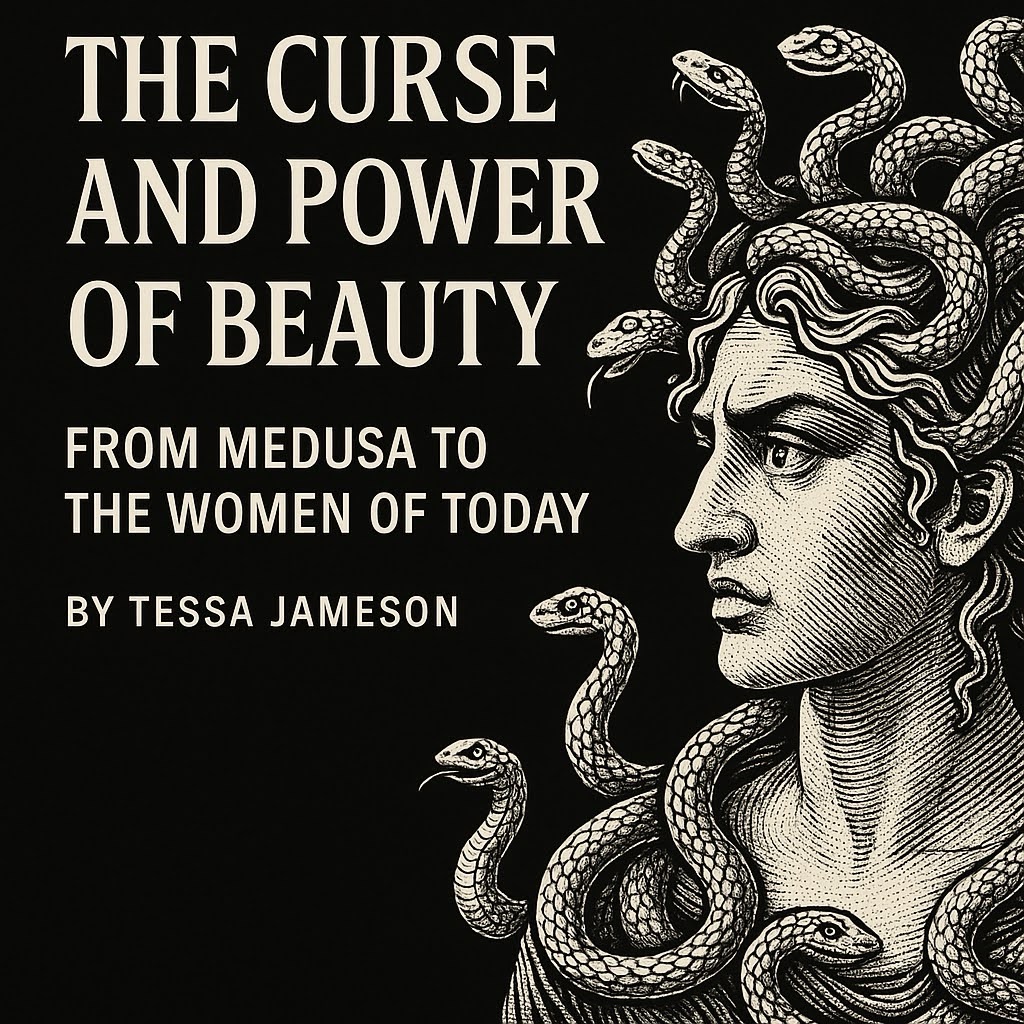
By Tessa Jameson
Introduction: When Beauty Isn’t Safe
We’re taught that beauty is something soft. Something desirable. Something that opens doors.
But in the deeper layers of story, myth, and history, it has always been more complicated than that.
Beauty has never just been a blessing. It has been a risk, a projection field, a place where power, desire, fear, and control collide.
Women who are seen as beautiful are often not just admired. They are managed, watched, defined, sometimes punished.
And even now, in a world of selfies, algorithms, and curated identities, beauty still carries that same double edge. It elevates you, then asks what it can take from you in return.
Medusa: When Violence Becomes the Punishment
In the original myth of Medusa, she is not born a monster. She is made into one.
A priestess. A woman in service to the sacred. Then violated in the place that should have protected her. And instead of justice, she is transformed into something unbearable to look at.
A body turned into warning sign.
A gaze that reflects back what others refuse to take responsibility for.
This is where the myth still hits modern life.
Because even now, survivors are often the ones who carry the consequences, not the systems, not the perpetrators. The aftermath gets rewritten onto the body of the person who was harmed.
We still do this culturally, just more subtly. We call it reputation. We call it credibility. We call it how she is perceived.
As if perception is neutral. As if it does not still turn people into monsters.
Persephone: The Disappeared Woman Who Becomes a Cycle
The story of Persephone has always been framed as seasonal mythology, but at its core it is about removal.
She is taken. Not asked. Not negotiated. Taken.
And then the narrative softens it into fate, as if fate makes it less violent.
Modern life does this too.
Women are still taken in less literal ways:
taken from autonomy through coercion dressed as romance taken from time through invisible labor taken from voice in rooms where they are interrupted, reframed, or translated taken from their bodies through systems that still debate ownership over them
And then we call it normal life. We call it relationship. We call it structure.
But Persephone keeps repeating herself in modern form every time disappearance is renamed as belonging.
The Sirens: When Voice Becomes the Threat
The Sirens were never dangerous because they attacked.
They were dangerous because they sounded like freedom.
That is the part that still echoes now.
Women’s voices, especially confident, sexual, emotional, or unapologetic ones, are still treated as something to regulate, to mute, to correct.
Online it shows up differently but clearly:
women harassed for speaking too loudly women discredited for being too emotional or too opinionated women punished in comment sections for simply existing visibly algorithms that amplify aesthetic value but suppress complex voice
Even now, visibility and voice are not always aligned.
The Sirens were not destroyed because they were wrong.
They were silenced because they were effective.
The Amazons: Women Who Refused to Translate Themselves
The myth of Amazons has always carried discomfort.
Because they are women who do not soften themselves for survival.
They are not waiting to be chosen. They are not negotiating their presence. They are not asking permission to exist in power.
Modern parallels show up everywhere women gather autonomy:
women-led movements framed as aggressive instead of organized ambitious women labeled intimidating instead of competent independent women treated as anomalies instead of norm shifts online discourse where self-possession is mistaken for ego
Even now, a woman fully in her own authority still disrupts something ancient in the cultural nervous system.
Not because she is unnatural.
But because she is uncontained.
Beauty as Resistance: When the Body Stops Apologizing
There are moments where beauty stops being about approval and becomes something else entirely.
It becomes language.
It becomes refusal.
We see it when:
people post unfiltered images in a culture built on perfection people wear what they want in spaces that expect compliance aging becomes visible instead of hidden bodies that were once excluded begin to take up space unapologetically
And it is not about aesthetics alone, it is about control.
Because what shifts is not how people look.
It is who gets to decide what looking means.
Figures like Frida Kahlo turned pain into visual sovereignty, refusing to separate beauty from truth. And voices like Alok Vaid-Menon continue to dismantle the idea that femininity must be soft to be valid.
Reclaiming the Gaze: The Shift That Changes Everything
The deepest shift is not in beauty itself.
It is in who holds the gaze.
For centuries, the gaze has been external, evaluating, ranking, approving, rejecting.
But something is changing.
Now we see people looking back. Curating themselves not for permission, but for authorship.
A scar is not hidden, it is documented.
A body is not corrected, it is expressed.
A face is not filtered into neutrality, it is allowed to be specific.
Even online culture reflects this tension. Beauty still gets rewarded, but authenticity is starting to interrupt the system that rewards it.
The gaze is no longer one directional.
It is becoming relational.
Conclusion: Beauty Was Never the Problem, Control Was
Myths warned us about beauty like it was dangerous.
But what they were really warning about was disruption.
Because beauty, when claimed on your own terms, stops being decoration. It stops being permission based. It stops being passive.
It becomes agency.
And agency has always been the thing systems struggle to metabolize.
So maybe beauty was never the curse.
Maybe the curse was what happened when people refused to stay small inside it.
And the power, finally, is in no longer apologizing for being seen.


Leave a Reply